
Sub-Total: $0.00

Lipstick Mountains Press Stories
Bold narratives for modern, thoughtful women.
Powerful Women’s Stories from Lipstick Mountains
Explore the Lipstick Mountains Memoirs, a captivating series of fictionalized novels celebrating strong, complex, and modern women. Each story offers depth, drama, and unforgettable characters.
The Lipstick Mountains Memoirs – Novels (Fiction)
- CHELSEA MATINEE – Memoirs of an Easy Woman
- SANDS POINT – Memoirs of a Money Trader
- RATTLESNAKE LODGE – Memoirs of a Seeing Woman
- HORSENECK – The Meaning of Ordeal
- MANIFEST DESTINY – Memoirs of a Dreaming Woman
- THREADS – Memoirs of a Weaving Woman (coming soon)
Each memoir blends emotional insight, personal struggle, and triumph, inviting readers into worlds of ambition, passion, and self-discovery.
Powerful Women’s Stories
from Lipstick Mountains
Explore the Lipstick Mountains Memoirs, a captivating series of fictionalized novels celebrating strong, complex, and modern women. Each story offers depth, drama, and unforgettable characters.
The Lipstick Mountains Memoirs – Novels (Fiction)
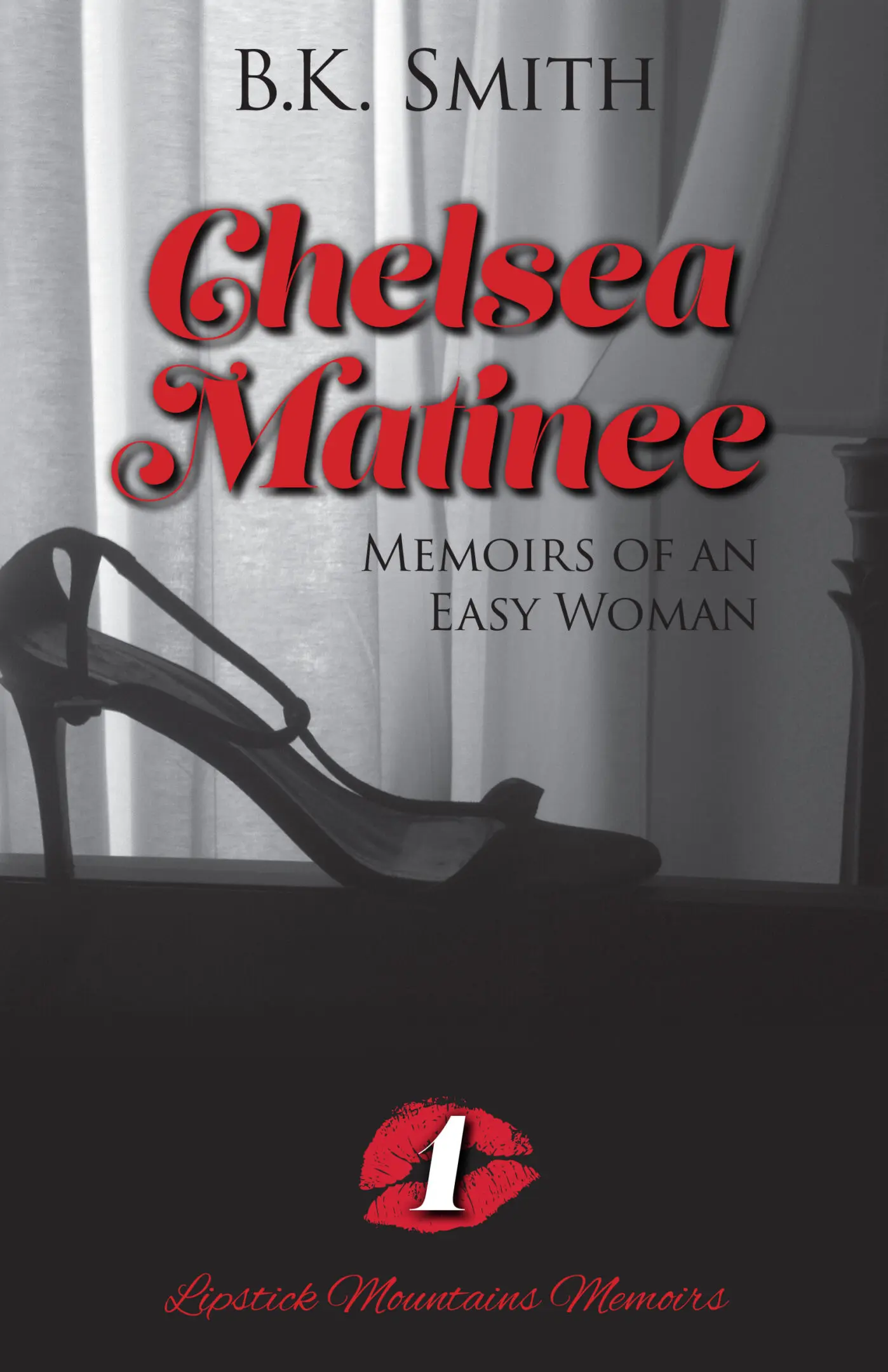
CHELSEA MATINEE – Memoirs of an Easy Woman
Chelsea Matinee by B.K. Smith:
The narratives of extraordinary women, the little black dress of women’s contemporary literature.
This is not an easy story to tell—it has taken more than thirty-five years to write—even though it has been told by one who is considered an easy woman.
It is not a simple matter being an easy woman because it’s difficult to be seductive all the time—and that is precisely the appeal of an easy woman. Men know that they can't have an easy woman at home; she must lead astray, entice, lead away from—these are all definitions of seduction. An easy woman is a woman of ploy. She is a paradigm of ploy-fullness. An easy woman makes you think, makes you question, and makes you believe—and mostly you covet the ease with which she does it.
Golden eras have always welcomed easy women as the charm behind the throne, the beguile-and-beckon of a long-endured marriage, a justified and gentrified departure. She made the king tender, vulnerable, and more understanding; she made the president walk around in her shoes, to see how he liked it, to feel the ache. The not-so-golden times have tried to deport her to vapidity. Perhaps this era, this moment in socio-economic history, cannot support her in quite the accustomed fashion of her predecessors, but she prevails none the less, and in most attentive company. More than you might imagine.
Narrating this story compels me to remember it and to give it substance. I will remember as well as I can in order to share with you this memoir, as discreetly as possible, because if it is sinister to call forth the dead from the tomb, it is even more so to call forth the dead from the living. But you must know about this lethal combination, ease and compliance, seduction and abandonment, and you must beware, and avoid it all the days of your life.
Even now, when I think about him, or quietly whisper his name, if only to myself, it burns my throat and leaves a profoundly sad and bitter aftertaste. May he rest in pieces.
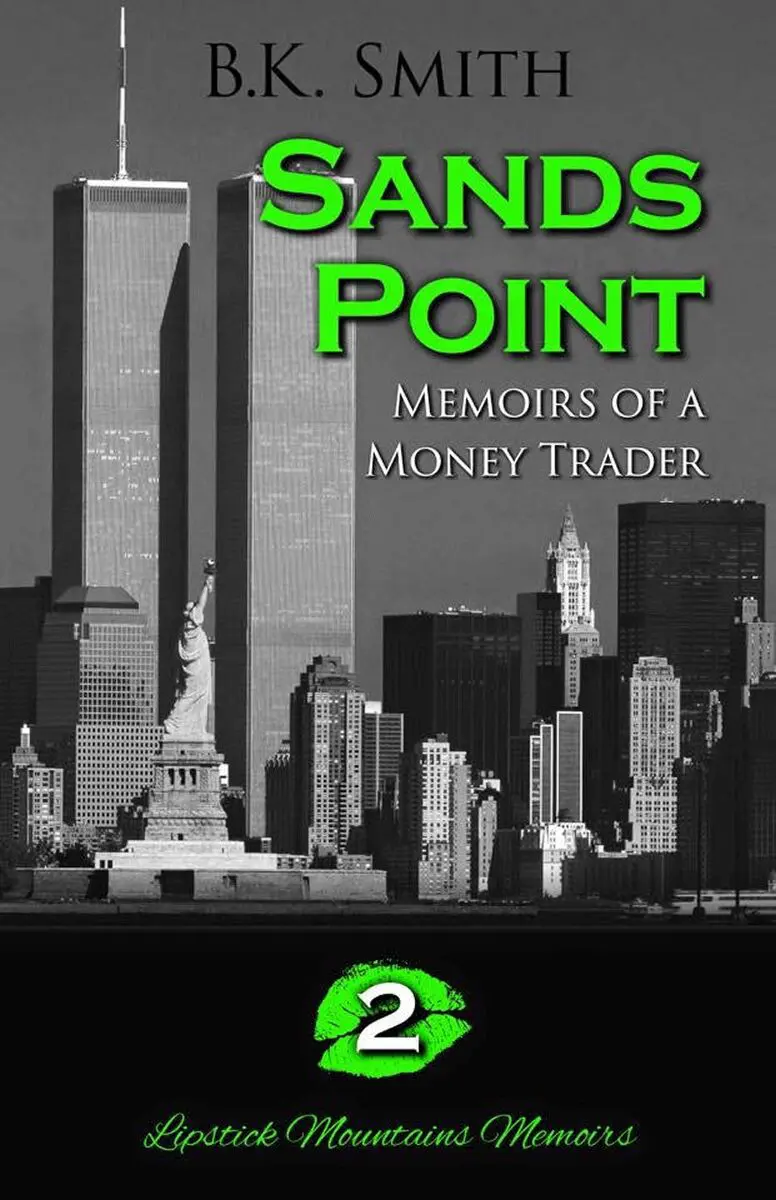
SANDS POINT – Memoirs of a Money Trader
Sands Point by B.K. Smith:
These are the new go-go years, the eighties, and money is plentiful—custom-made designer clothes, champagne cocktails at Windows on the World, limousines lined up in front of the trendiest restaurants and private clubs along Park Avenue. The WTC is a beacon and venue for money traders. The US dollar is strong and cash, as always, is king. It is a decade of fast cars, fast markets, and fast talkers. And then the music stops. The yield curve is inverted, S&Ls are insolvent, OPEC is a dangerous cabal, Petrodollars and Eurodollars are flooding the financial markets, and countries are defaulting on loans.
Billions of dollars disappear from the Vatican Bank, and the bank chairman, Roberto Calvi, is found “suicided” under the Blackfriars Bridge in London in 1982.
Meg is an aspiring actress, married to Dick, a struggling director. They live over a deli in a tenement on the upper eastside. What she dreams of is being married to a filthy rich man and shopping at couture salons on Madison Avenue.
Becky is writing a novel, living in Sand’s Point on Long Island, married to Kevin, a successful money market broker on Wall Street. She has everything a woman could want, but love.
Alex is a middle-aged playboy who owns several businesses in town, drives a sports car and fantasizes about both of these women—but he’s married.
They are all married. None happily.
Is money the cause of all unhappiness—too little, too much, never enough—and is it the root of all evil?
Meg, Becky, and Alex never suspect what is really going on and where they will ultimately end up. Can money manipulate their destinies? Is it fate?
A novel of fast money, easy money, love, sex, betrayal, international scandal, embezzlement, and murder.
A modern story of the profound and deadly effects of deception.
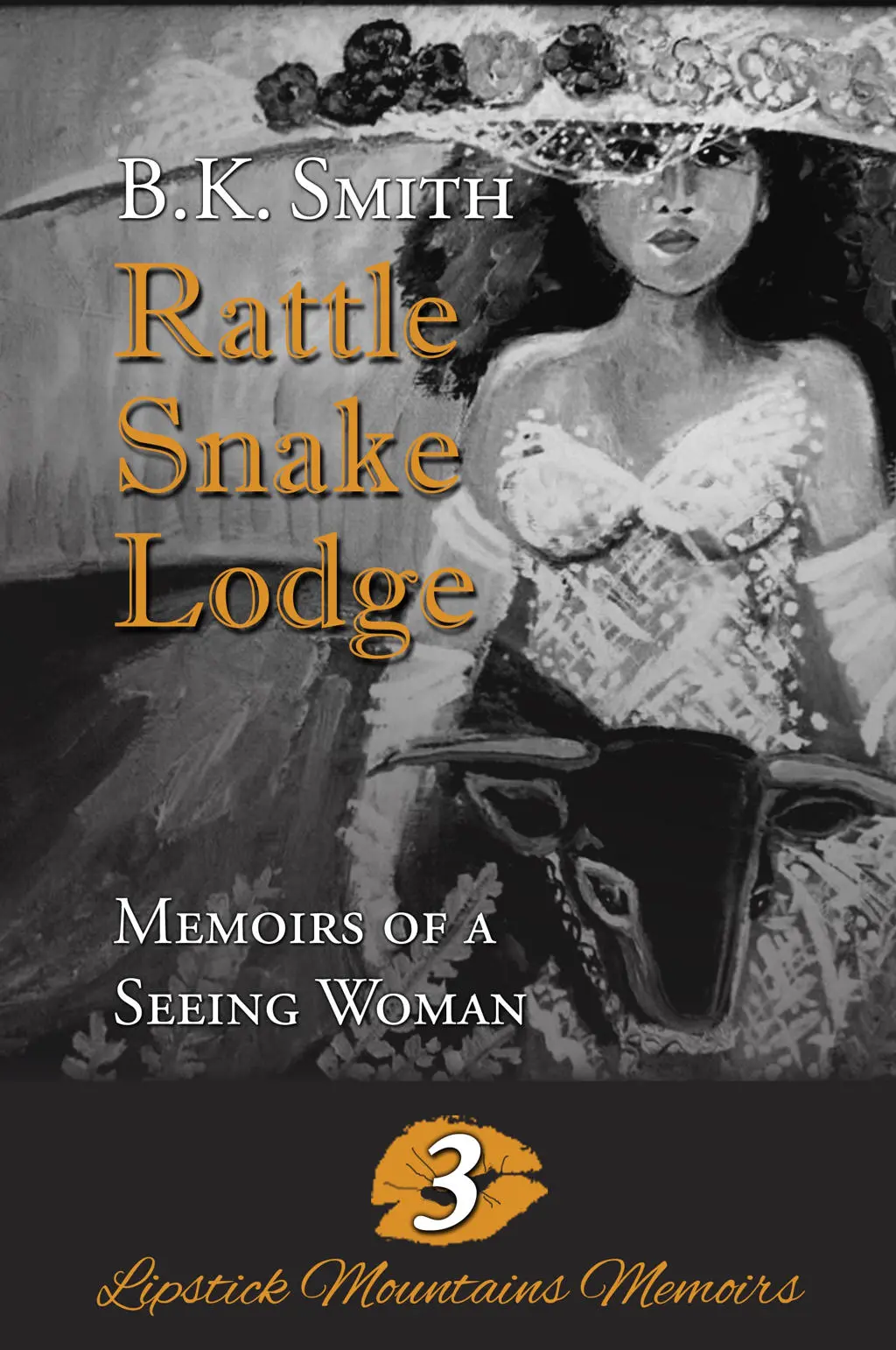
RATTLESNAKE LODGE – Memoirs of a Seeing Woman
Rattle Snake Lodge by B.K. Smith:
MY NAME IS AMANDA FRENCH. My family name French, I believe says it all. We, the French women, were born to wear elegant clothing and accessories, the finer brocades and silks, fluid and cool, raw dupioni and nubby shantung, the texture that is pure sex to the hand that appreciates.
All the women in my family have some sense of the future and will tell you what it holds; and even before I was sure what it was, I knew I had it, the power to see. My grandmother, a healer, could interpret the sky; predict weather patterns, upcoming anomalies, drought, that sort of thing. My sister read hands; tiny crooked lines leading up and down, front to back, thumb to wrist, are the roads she helps to navigate. My aunt could read dreams and tell an expectant mother the sex of her unborn baby. My great grandmother could heal “troublesome ailments” and call out evil spirits from the sick, the overlooked, and cursed alike. And her mother, my great great grandmother before her, was known to associate with ghosts, the spirits that have passed over but not before promising to return and tell all, which they did by channeling through her in different languages. Her sister, my great aunt, could tell you the day and time of your birth and the day and time of your death.
Sometimes I know the future in my breast. Sometimes I see the future coming out like a picture show, images that seep into your head the way rainwater collects in a basement corner, gathering from no place in particular. More often though, I see events in tea leaves, little bits of myself floating to the top of a shapely Spode china cup, tentatively dancing along the fragile gold leaf rim like your last memories in the few minutes before death. Often as I would stare down into my tomorrow, wondering if I should drink the brew or run to the sink and pour it down the drain, I would often do the latter. It’s not that a particular vision was so frightening or alien—I grew up after all with these gifted women around me conversing with entities neither you nor I could see—it’s just the memory of seeing trouble early in a courtship and remembering what it felt like, one lone tear snaking down my face, and my words all square and neat as I told him, “I love you but… I see no future.” Or, I did see a future and there was no happiness in it. But, with this man, with Reed, I never saw a blessed thing. I never saw anything at all in the beginning. If I had, it would have been as shocking I’m sure as seeing blood on the moon. I guess it’s true what they say, that you never see the bus that hits you.
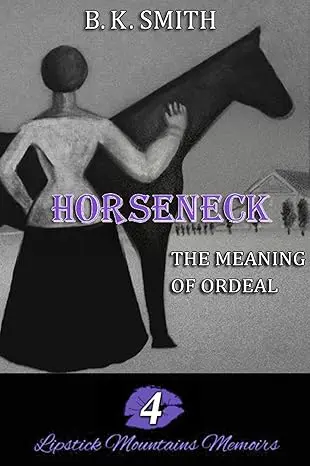
HORSENECK – The Meaning of Ordeal
I finally detached with the understanding that people cannot give to you what they don't have. I am not feeling the love because... And because of what was probably this unsatisfied need for affection, I have a history of trusting complete strangers, some of whom have, to their credit, risen to the occasion by displaying the kindness thus expected of others at the eleventh hour. I made friends easily. One day, impelled by mutual attraction, or curiosity, you strike up a conversation and discover shared interests and a new friendship is born. You try to live the same hopes and dreams, feeling at ease, even happy, and this friendship becomes part of your life, a little bit like family. Then treachery strikes and a great desolate wind sweeps away those dreams. Wounded and angry, you wish you were dead for ever thinking or believing and falling for it again.
Then other similar mirages appear on the horizon, as you walk in your own landscape, and you rise to the occasion once again, and you are disappointed once again, and one fine day all that is left of your spirit is a tiny scar on your heart no bigger than a fingernail scratch. You no longer feel anything either. You no longer care.
Only many years later, only when I had given myself passively to this lovelessness in the conviction that I had metamorphosed from a loveless childhood to the adulthood of more of the same, disappointment, betrayal and loss. Only with this wisdom had I come to believe in nothing, and only then was I surprised by love.
What is the meaning of ordeal? You'll know it when you know it.
This book contains "Papier Mache Bowls - Vessels of Grieving.
42 full-color photographs,"The creative meaning of ordeal.
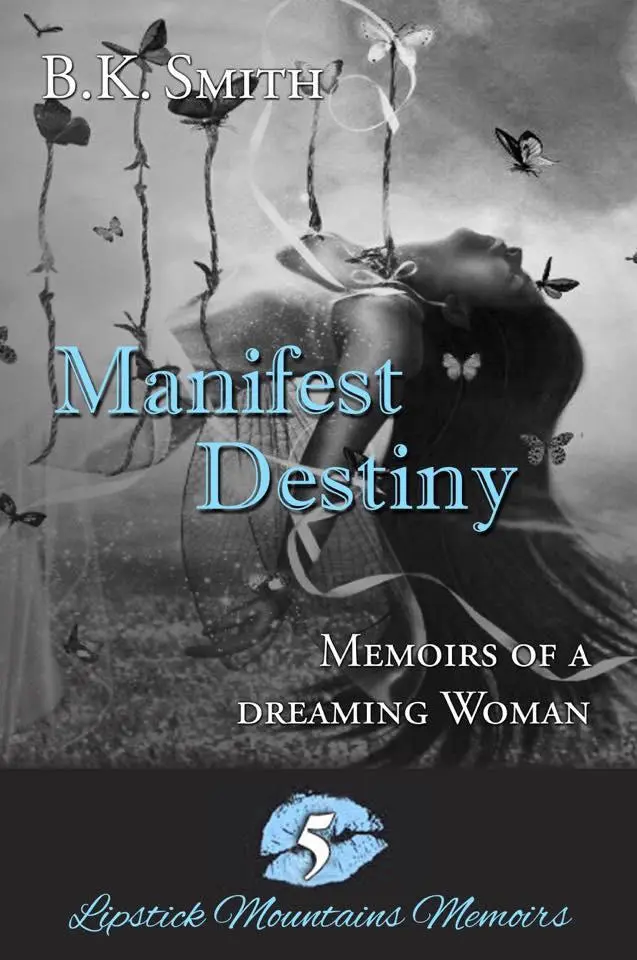
MANIFEST DESTINY – Memoirs of a Dreaming Woman
Manifest Destiny by B.K. Smith:
In the southern Mazatzal Mountains where “Four Peaks” pokes through the clouds, just north of Apache Lake, and opposite the Superstition Wilderness of Arizona, a solitary Indian climbed a grassy slope to a flat ledge of dark boulders that overlooked the Rio Verde River and the valley of waving tabosa grass below. A spirit side-winded through the stems. The spirit was a snake of air. It writhed up the slope to the very spot where the young man stood. Just before it reached him, the Indian closed his eyes. Wind touched his straight black and silver hair and rustled it about his face and neck.
The Indian lay down among the rocks, his face turned to the sky. Only his eyes moved. It had been years since he came to this sacred place and put his back against these holy rocks. Today he came to ask for his name. This name would be given to him by a spirit, a sort of guardian spirit, who would leave a talisman. If the spirit were a bird, it would leave a feather, which the Indian would tuck into his boot. If it were a bear, it would leave a claw.
In the old days humans and animals were the same. They talked freely to each other and helped in times of battle and famine. Sometimes the spirit was a human, the ghost of someone who has passed on to a gentler place, more often it was a frustrated ghost with chores undone, words unspoken or gestures yet undemonstrated. And sometimes the spirit wandered off into the desert and never came at all. The Indian would not learn his name and he would wither away and die young, bereft of the taproot of his existence.
The searing Arizona sun climbed higher, slowly higher.
The Indian wondered if he was out of his time. Too early or too late. Perhaps the spirits have been chased away by the influx of new settlers from the mid-west and over-stimulated tourists from both coasts. But he did not really believe that. He knew they prevailed. He knew the spirits of his ancestors were everywhere up here. Always stirring the air, like a pot of boiling waters. They were here long before the white man came onto the land. They had lived long before a man was nailed to a cross. They live here now, today, in this place. Many of them. They light and go again, fading into the desert backdrop, the lightning, and the blowing sand. They are the spirits of this place—all the way down to the river. And they let it be known. Indeed, they let it be known.
THREADS – Memoirs of a Weaving Woman (coming soon)
“Yes,” she wrote. It was all she wrote, and he didn’t know quite what it meant, quite what it was she was saying. Was she saying…? He stood up and sat down again. It was something arresting, a thought or a notion; it buzzed around inside his head like a bee in a glass jar. Yes. It made him smile and then it made him roar with laughter.
It was James Joyce’s wonderful Molly Bloom in Ulysses, breathless, "...I was a flower of the mountain yes when I put the rose in my hair like the Andalusian girls used or shall I wear a red yes and how he kissed me under the Moorish wall and I thought well as well him as another and then I asked him with my eyes to ask again yes and then he asked me would I yes to say yes my mountain flower and first I put my arms around him yes and drew him down to me so he could feel my breasts all perfume yes and his heart was going like mad and yes I said yes I will Yes…"
Yes, that was the beginning.
To be taken or not to be taken is a matter of trust, desire and the willingness to be taken. It has been compared on occasion to jumping out of a perfectly good airplane, where you just allow yourself to fall, knowing and hoping that you will land safely. You land changed. Not necessarily for the better, or the worse for that matter, but you do land, however changed.
I wasn’t looking for anything or anyone. I don’t even know why I was looking, but then I saw him, his picture, and it spoke to me, but I didn’t grasp the message, its meaning. I contacted him anyway.
“I know you,” he said.
“Oh? I don’t think so.”
“Yes. I know you. I kissed you on an escalator.”
“Someone else,” I said. “I never…”
“Oh, yes. It was a long time ago. You don’t remember me.”
“No.”
“I remember you.”
We exchanged emails throughout the evening and the haze began to lift and I saw us on an escalator at the Biltmore in Phoenix and we did indeed kiss on an escalator. We went up and down the escalator several times and we kissed deliriously, like deer at a salt lick. And suddenly the room began to move and his words were hard to read and I found myself breathless—and to some small measure afraid.
There were moments in the near prior months when I had begun that itching thing that happens when my life is about to change in some dramatic way. Someone or something is leaving, or someone or something is entering.
“Maybe we could meet for coffee,” he said.
“Ok,” I replied.
“Ok…” he drawled. “When would you like to do that?”
“Sunday?”
“OK…” he drawled again. “Would you like me to pick you up?”
I wanted to say yes, but the thought of saying yes so soon wasn’t plausible. I couldn’t say yes yet, and I couldn’t say no. I said instead that I would meet him there, at the little French Bistro where we would drink Camparis and try not to smile so much.
“The years have been kind to you,” he said. He kissed both of my cheeks European-style. I tilted my face to the left and to the right to receive his kisses. His lips stopped a fraction of an inch away from actually touching skin.
“Misery becomes me,” I answered, partly kidding, partly serious. But he didn’t seem to hear, or else he did, but chose not to respond.
“Do you remember me?”
“Yes,” I said.
I did remember him. I remembered parts, not all. He reminded me of bits, what was meaningful for him, and pieces, selectively chosen to share with me, and I felt comfortable with him instantly because he remembered me, and more because he remembered a part of my life that had virtually been forgotten.
“I never forgot you,” he said.
I apologized to him—I don’t know why--, it was during a traumatic time for me. So traumatic I have blocked most of it out. That’s what I was apologizing for. I blocked you out, oh dear, but it wasn’t you, it was me… Aren’t those famous last words.
“How long did we…?”
“Date?”
“Yes,” I said, embarrassed.
“A little more than a month.”
“Did we…?”
“No.”
“What happened?”
“I believe we didn’t quite connect.”
“Apparently.” I shook my head slowly. I tried not to smile so much.
“I will never forget the escalator ride. Apparently, you did.”
“Did you stop calling, or did I stop taking your call?”
“Now you’ve got me. I don’t remember.”
We paused. His eyes rest on a memory bounced and came back. He smiled.
What he did remember was every restaurant we ate in, every bottle of wine we drank, every conversation, the way I smiled, the way I laughed, the way I walked.
“You walk like a dancer,” he said. “If I saw you walking through a crowded airport in Europe, I would know it was you.”
My heart aches as I write these words. Once again, nine years later, almost to the day, this man, this same man, enters, tall, dark and handsome, with the most beautiful dark eyes I have ever seen, reaches across the table and offers me a golden parachute.
Can we rewrite history?
I am too pragmatic to think so. But I had just recently crossed something monumental, and not very pragmatic, off my list of things to do before I die. I packed on a parachute and I released and fell out of a perfectly good airplane two miles high. I fell through the air, free as a bird, and when the parachute opened at 5,000 feet, I felt the warm air embrace me and softly guide me down to earth. Forever changed. Open and fearless.
A week or so later I am sitting in a little bistro in Scottsdale, with a re acquaintance, open, fearless.
D is talking fast, and in an excited way, he tells me that he bought a house in San Miguel de Allende, Mexico and he will be moving there. He is drawing pictures on a scrap of paper of the house, the town, the lake, the people. As he speaks, I am fixated on his mouth, as he forms his words and smiles at me.
“What do you have to lose?” he says, returning my gaze, a brilliant glint in his eyes.
Now I think that maybe the Campari is swishing around in my brain, but I am still open and fearless, and the warm air once again envelops me: come with me, be forever changed.
“I don’t speak Spanish,” I say.
“I’m fluent. You’ll learn. They speak English there. There is a large ex patriot population.”
“I have a life here.”
“You’ll have a life there. A better life. If you want it.”
“I’ll be totally dependent on you. Until I know the language, of course”
“I’ll take care of you financially. You can do whatever you want. Get out of this rat race. You can paint and write. You can do that anywhere. Why not do it at 7,000 feet in this magical place? If you don’t like it, you can come back to the states. What do you have to lose?
I think of you when I’m trying to go to sleep.
I think of you when I’m awake.
I dream of you…”
Later that evening, I researched San Miguel de Allende and Ohhh I fell in love for the second time that day.
It was impossible, I knew, madness born of the shortening day and long nights and the winter stars. Yet the firelight wove his words into bright images, and my deepest-held dreams seemed for a moment close enough to reach. I was prepared to risk a good deal to touch just one of them. And really what did I have to lose? Him. And I was going to lose him anyway.
The following morning, I emailed him. “Yes,” I wrote.
Each memoir blends emotional insight, personal struggle, and triumph, inviting readers into worlds of ambition, passion, and self-discovery.